by Don Berryman
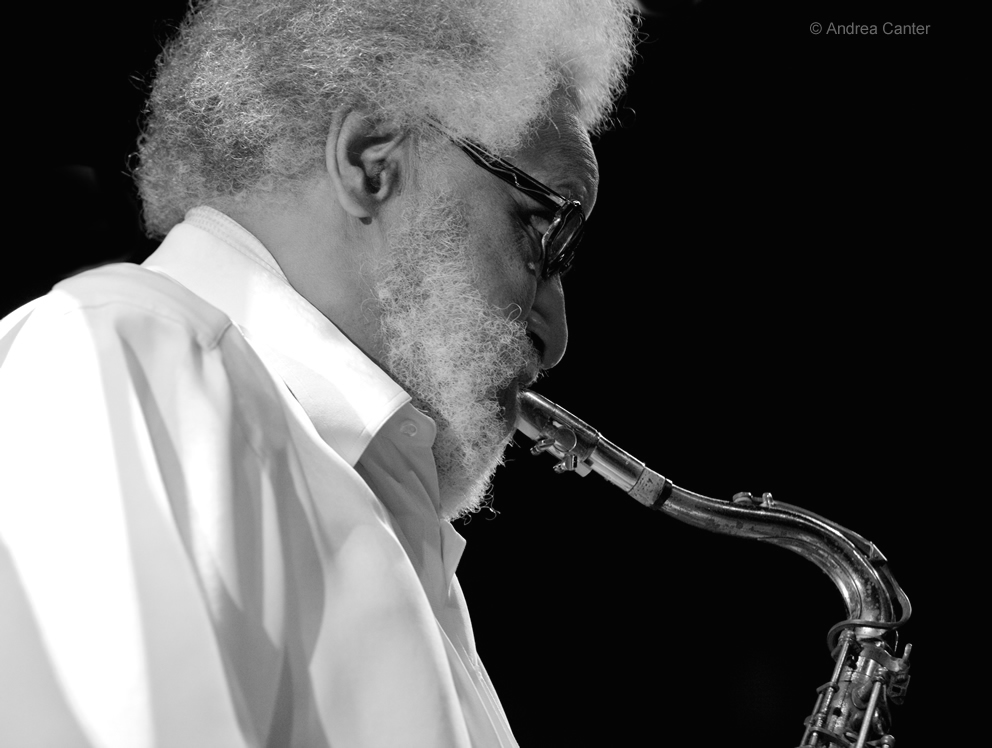
One of my favorite saxophonists of all time and a giant of jazz, Sonny Rollins, died at his home in Woodstock, NY, on May 25th, at the age of 95. If there was a Mount Rushmore of tenor saxophonists, Sonny Rollins would certainly be on it.
In the 1950s, Rollins began by working as a sideman on recording sessions with Miles Davis, Thelonious Monk, Art Farmer, and the Modern Jazz Quartet. In late 1955, while living in Chicago, he replaced Harold Land in the legendary Clifford Brown-Max Roach Quintet at the Bee Hive club. He remained a regular member of that quintet until Brown’s tragic death from an auto accident in June 1956.
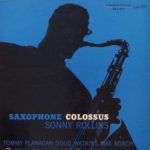
My introduction to Sonny Rollins was listening to the 1954 Miles Davis album Bags Groove, particularly digging Sonny and being introduced to his tunes “Oleo” and “Doxy”. The first Rollins album I bought with him as a leader was Saxophone Colossus which lived up to its name and introduced the calypso composition “St Thomas”. When Rollins then began to record in a trio format, without piano, on A NIght At The Village Vanguard (with Wilbur Ware and Elvin Jones) and Freedom Suite (with Oscar Pettiford and Max Roach) these recordings really laid bare the elements of the music and open space for solos that expanded my understanding of jazz.
In a 2017 NEA podcast by Jo Reed (click here for complete interview) Sonny Rollins responds to a question about his decision to work in a trio format:
 “I like to play by myself. And, I’d like to go out and play by the water, by the ocean. I go in the park, anyplace where I can be alone with my saxophone. That’s what I always like to do, and the idea of the piano, which is a beautiful instrument and I’ve played with some great piano players, is the piano is a very dominating instrument. So, when I was playing with Miles, his band, we used to do a thing which we called stroll. Stroll means that in the middle of a number you’re playing, the piano lays out (that’s what strolling was). We used to do that all the time. I loved strolling. I always like to put all the music in my head, create it myself, patterns, ideas, thoughts, passages, anything like that. I needed to have complete freedom to do it. So, I made plenty of records with saxophone, bass, and drums. That was sort of the thing I became famous for doing. And that’s sort of where it came from. That was the impulse.”
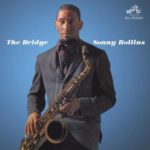 By 1959, Rollins’ popularity had grown immensely, but he decided he needed more serious woodshedding and took a two year hiatus. He practiced his horn deep into the night on the Williamsburg Bridge, which crosses the East River from Manhattan to Brooklyn. In 1961 he emerged refreshed with a new sound, Sonny Rollins 2.0 as it were, and returned to the scene. He made recordings with musicians such as Jim Hall, Don Cherry, Billy Higgins, Herbie Hancock, and bassist Bob Cranshaw, the first of which being the aptly named The Bridge. In 1966, he composed and recorded a soundtrack album for the film Alfie.
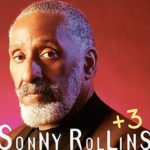 In 1968 Rollins took another break from the jazz scene, returning in 1971. He continued playing and growing into the new millennium, working almost exclusively on concert stages. In 1987 he was awarded the NEA Jazz Masters Fellowship. In 2010, he was elected a fellow of the American Academy of Arts and Sciences and was awarded the National Medal of Arts.