
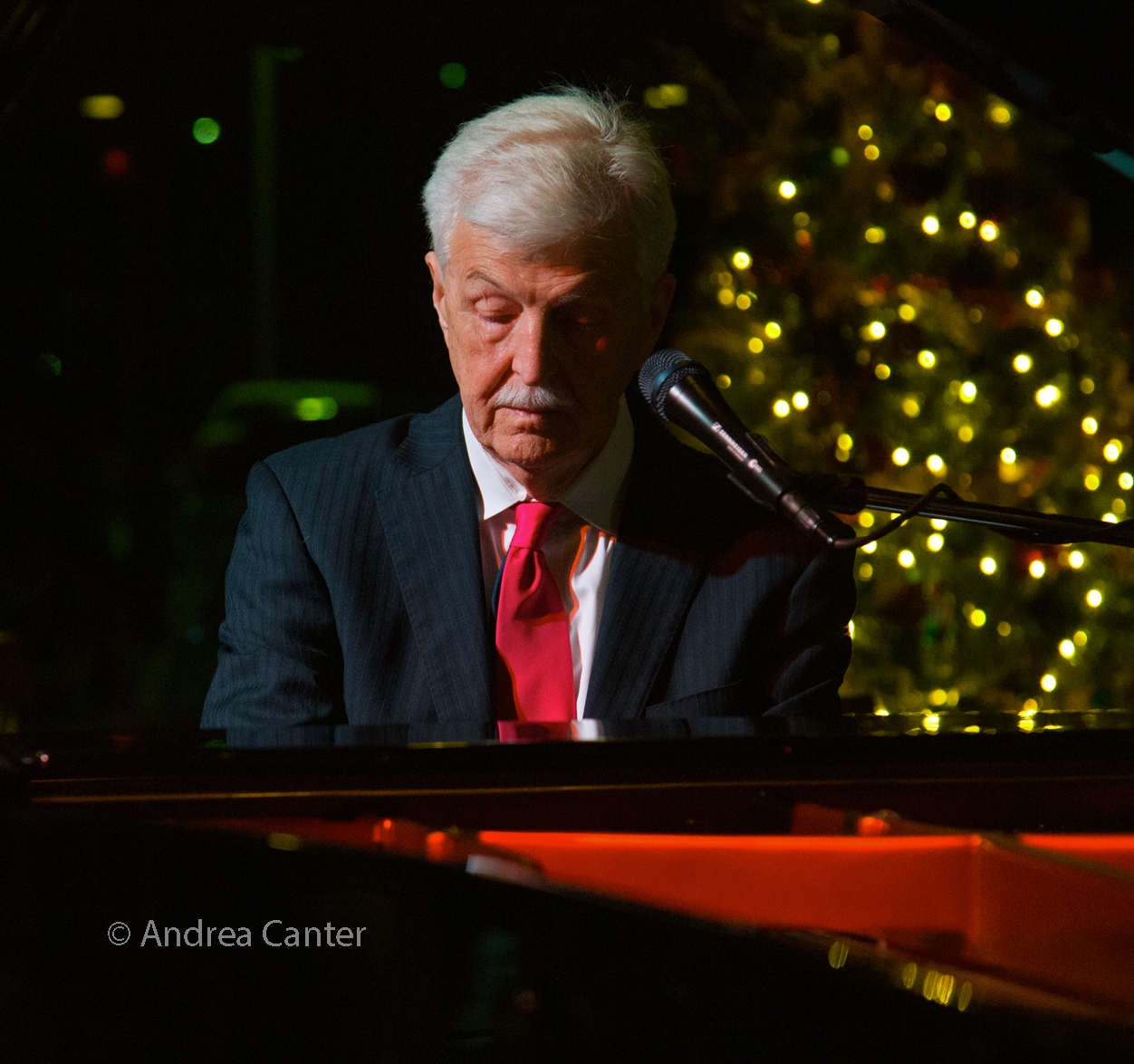
 Dave Frishberg © Andrea Canter “I want
to be young, I want to have fun, I want to be a sideman." –David
Frishberg, “I Want to be a Sideman”
He may prefer to be just
a
“sideman” but Grammy-nominated pianist/singer/songwriter David
Frishberg has attracted a near-cult-like following over his
multi-faceted career. Originally working in the shadow of jazz
legends like Ben Webster and Gene Krupa, Frishberg the pianist
morphed into Frishberg the songwriter, gaining fame with such gems as
“Peel Me a Grape,” “Blizzard of Lies,” “My Attorney
Bernie,” and, of course, “I Want to be a Sideman.” A Portland,
Oregon resident for the past two decades, Frishberg brings his wit
and musicianship to the Jazz Bakery in Los Angeles, December 6-9.
Nothing like getting the holiday season off to a roaring start!
Early Career
David Frishberg spent his
childhood in St. Paul, MN where he worried his parents with his
interest in music. He once wrote that “My
parents listened to my pianistics with puzzled disapproval, and I
once overheard my dad telling his friends that I wanted to be a
'klezmer' …a low class performer, a clown, maybe a step above organ
grinder." But as student at St. Paul Central High School,
he was already jamming with other young musicians, and notes that he
started playing professionally while at the University of Minnesota.
At this point, Frishberg only played piano. “It never entered my
mind to sing.” Just before graduating from the U of M in 1954,
Frishberg played a “real gig” for a few weeks at the Key Club
near the Minneapolis campus. “It was a big thrill to really play at
a jazz club and not just sit in,” he recalls.
Following college
graduation, Frishberg enlisted in the Air Force for two years, moving
to New York City after his discharge in 1957. His first gig in the
Big Apple was a day job. “You had to be a New York resident to get
a union card, so I worked as a copy writer” for a radio station and
later for RCA, writing copy for their catalogs.” Once his residency
was established in 1958, David left day work “for good” to become
a fulltime musician. He initially performed solo and as an
accompanist for singers in the Village, later working for Kai
Winding’s 4-trombone band. He then worked a year with Carmen McRae
before becoming “a regular player” at New York jazz venues, later
joining Gene Krupa’s Quartet for three years and making his first
recording with Bud Freeman. A year with Ben Webster followed.
Frishberg notes that his favorite position, though, was with
Al Cohn and Zoot Sims. “We played at the Half Note in New York.
Jimmy Rushing was our singer—he’d join us on weekends. The love
and feeling of that band and the music we played, the cast of
characters we had, was fabulous.”  Dave Frishberg © Andrea Canter
Looking back, David
identifies three individuals who most influenced him personally and
musically—Al Cohn, Jimmy Rowles, and Dave Karr (his old high school
buddy who still blows a sweet horn in the Twin Cities). In addition
to Teddy Wilson, Mel Powell, and Nat Cole, he was “a big fan of
Tatum and others—Errol Garner and the boppers, Al Haig, and Bud
Powell.” But it was particularly Jimmy Rowles whom he admired. “I
was already in the Twin Cities Big League, but then I heard a Jimmy
Rowles record. Something about the way he played and touched the
piano changed me. I wanted to play with and learn from him…Rowles
had everything.”
Singing and
Songwriting
on the West Coast
David released his
popular
Oklahoma Toad on CTI in 1968, and shortly thereafter moved to
Los Angeles to work as a television studio musician. For a while he
was employed by Herb Alpert, a gig he once described as “the
most fun I'd had. I got a solo spot and played some of my Jelly Roll
Morton stuff." He was also recording for Concord, issuing such
gems as Getting Some Fun Out of Life in 1977. But
until about 1980, it had never occurred to Dave to sing “for real,”
although he had already had some success with songwriting. (His
baseball-themed “Van Lingle Mungo” was a surprise hit in the late
60s.) But in LA, he was writing jingles and songs, including “Listen
Here” which he wrote for the Mary Tyler Moore Show. “I had
just gotten into songwriting and I started to sing—I needed to make
demos. I got good feedback from the audience and decided it might be
fun to do it for real.” The economic realities of the music
business also pushed Frishberg more and more into songwriting and
singing his own material. “A lot of music jobs had disappeared.
Fortunately I could turn left and find another channel. My life
changed—I was writing for me, not just for others. I had a new
life—I was no longer just a sideman.”
In 1986, David moved
again, this time to Portland, OR where he still makes his home.
Today, he is refocusing on the piano, and describes his tastes as
“older forms of jazz, the jazz of another era—what I played in
New York.” He listens to his collection on a revolving basis. “I
bring up tapes and records from the basement. Sometimes I listen to
nothing but Duke Ellington. And also I listen to singers—Peggy Lee,
Billie Holiday, Fred Astaire.”
A night with David
Frishberg is a night of pure entertainment in the hands –and
voice—of one of America’s great treasures of music. Don’t miss
this special gig at the Jazz Bakery, December 4-6.
“Finely-tuned
melodies, carefully-crafted lyrics and a liberal dose of wit are the
hallmarks of Frishberg’s style, which takes its own idiosyncratic
twists and turns. (He's a heck of a piano player too!)” –Jazz
Bakery
David Frishberg
appears
at the Jazz Bakery in Los Angeles (3233 Helms), December 6-9, shows
at 8 and 9:30 pm. Tickets and information at
www.jazzbakery.com.
Click here for the full Jazz Police interview with David Frishberg. |