


JP Jazz Police Advertisement

Hotel Search by Jazz Police

Rooms:
Adults: (age 19+) Children:
Room 1:
  Home arrow New and Notable
Main Menu
Home
New and Notable
Photo Galleries
CD/DVD/Book Reviews
Interviews
SF Bay Area
Chicago
Los Angeles
New York
Twin Cities, MN
Festivals
News
Follow Jazz Police on Twitter
Like the Jazz Police on Facebook
 Tuesday, 21 May 2013
New and Notable
Curtis Fuller: I Will Tell Her (2010, Capri Records) Print E-mail
Written by Glenn A. Mitchell, LA Jazz Scene   

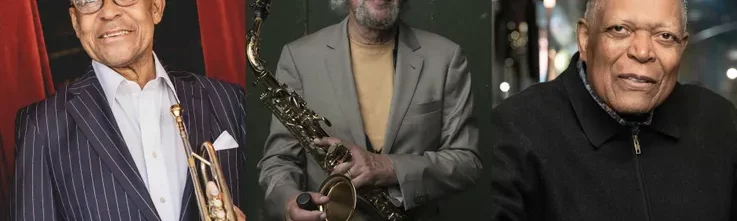
ImageThis new 2-volume CD release shows acclaimed trombonist Curtis Fuller at his very best in both a live performance and studio setting. Jazz belongs to everyone here! This CD is mellow, magical and strong. The performers are tight! It is dedicated to Cathy, Fuller’s wife and soulmate of over thirty years, thus the title I Will Tell Her. As Thomas Burns points out in his liner notes to the CD, “The versions of the live tunes are very different from their studio counterparts and have an entirely different energy.” Fuller’s sextet is made up of the best musicians, who play totally together: Curtis Fuller (trombone), Keith Oxman (tenor sax), Al Hood (trumpet), Chip Stephens (piano), Ken Walker (bass) and Todd Reid (drums).

In listening to the first disk, the Curtis Fuller Sextet in the studio, I was very happy with the numbers, especially the beginning tracks. In “Time Off,” I was amazed at the cohesiveness of the entire sextet and their remarkable playing. Fuller’s trombone is dominant. The piano runs from Chip Stephens were some of the best I have ever heard anywhere! “Sagittarius” is a mellow piece that grooves well. Trumpeter Hood takes the melody and then Stephens moves it with his soloing through the next choruses with the horns backing him. The Kenny Dorham “Minor’s Holiday” makes many jazz statements from not only Hood’s trumpet, but Oxman and Fuller, then Reid’s drumming. The title tune “I Will Tell Her” is meaningful and serene. Without mentioning every piece in the CD, I can easily say the each is a gem.

On the second disk, we are now live at their annual gig in Denver at the Dazzle, one of Denver’s main jazz venues. They begin with Sonny Rollins’s “Tenor Madness,” the sextet stretching out comfortably for their audience and for their own relaxed playing as well. A nice groove goes over well in Fuller’s own “The Maze.” The horns all take turns in providing excellent choruses and Stephens takes the sextet to the tune’s end. The live audience gives consistent applause. This is a superb example of jazz at its best. Recommended.

Posted with permission from L.A. Jazz Scene, November 2010 issue

 
Doug Webb – Midnight (2010, Positone) Print E-mail
Written by Glann A. Mitchell, LA Jazz Scene   

ImageOne of the best saxophonists on the scene today is Doug Webb. Webb always produces a vibrant, zesty sound on his tenor and soprano saxes. His new CD is magnificent and includes eight selections, all pretty well-known tunes. The quartet includes Larry Goldings (piano), Stanley Clarke (bass), Gerry Gibbs (drums) and Webb (saxophones), with special guest pianists Joe Bagg on tracks 1 & 4 and Mahesh Balasooriya on track 5. I like every tune on the CD. Each offers true jazz music, relaxes the listener and is better with every listen!

Starting off is “Try a Little Tenderness,” building on a nice melody, then creating smooth interplay with solos from Webb and Bagg. Alec Wilder’s lovely ballad, “I’ll Be Around,” provides peaceful time. Some great listening is provided by both “Fly Me to the Moon” and “You Go to My Head.” “The Boy Next Door” is very alive; Webb’s saxophone on this gem is marvelous and Balasooriya’s piano work sets the bar high.

The rest of the quartet plays relaxed throughout the recording. In “Crazy She Calls Me,” Clarke produces an outstanding bass solo that defines the entire tune. Parker’s “Quasimodo” develops quickly into the normal blues mode that he wrote for many of his famous compositions. The quartet blends wonderfully on Johnny Mandel’s “Emily.” Gibbs’s drumming is eloquent and quietly distinctive with the quartet and Webb’s delicious sax sound to peacefully close off this excellent CD.

Reprinted with permission from L.A. Jazz Scene, November 2010 issue

 
Ryan Cohan Deserves “Another Look” (2010, Motema Records) Print E-mail
Written by Andrea Canter, Contributing Editor   

ImageChicago native Ryan Cohan has already distinguished himself as pianist, composer and bandleader. His working quartet (the core of this recording) was chosen as one of only a handful of ensembles to tour internationally on behalf of the U.S. State Department through the Jazz at Lincoln Center’s Rhythm Road program in 2008 and again in 2009.  Cohan’s 2007 Motema release, One Sky, earned accolades as one of the year’s top recordings. Thus expectations were appropriately high for Another Look, the quartet’s debut collection of 9 original compositions and two covers, with special guests, vibes titan Joe Locke and percussion master Steve Kroon, joining Geof Bradfield on sax, Lorin Cohen on bass and Kobie Watkins on drums.

The opening “Monkin’ Around” heralds the compositional finery of the set as well as the elastic phrasing of Joe Locke. Cohan manages to blend strong swing with rhythmic twists, and my first encounter with Geof Bradfield is a delight. The title track shines the spotlight on Locke, shifting from assertive melody to balladic song to acrobatic
improvisation, with increasingly strong and percussive Latin rhythms, courtesy of Cohan (at times suggesting Ahmad Jamal) and the rhythm section. Latin beats fuel Cohan’s spikey arrangement of “Caravan,” highlighting percussionist Kroon as well as the leader’s extensive rhythmic vocabulary and penchant for gear-stripping turns.

Two compositions are divided into two parts, two tracks each. Bradfield goes solo on the tenor intro to “Gentle Souls,” 90 seconds of incantation leading into the sextet’s track and Bradfield’s switch to soprano. Cohan weaves a golden braid with Locke before settling into an exquisite trio conversation that delicately recalls Evans and Jarrett. Just when the track seems to reach resolution, Bradfield builds a haunting bridge between piano and vibes. Another two-part composition, “Song for My Grandfather” opens with just Cohan combining majestic chords and arpeggionated flourishes before yielding to the core trio, the pianist’s slight hesitations in tandem with elegant phrasing again suggesting Jamal; bassist Cohen solos with similar finesse.

The boppishly swinging “Steppin’ Up” closes the set, its high-energy propulsion ignited by Cohen and drummer Kobie Watkins, and with Joe Locke, evokes strong memories of the Modern Jazz Quartet. Another Look confirms Ryan Cohan as a seriously creative force in the composing, arranging and bandleading arenas of modern jazz.

 
Bruce Barth and Steve Wilson Find “Home” (2010, We Always Swing) Print E-mail
Written by Andrea Canter, Contributing Editor   

ImagePianist Bruce Barth and saxophonist Steve Wilson have impeccable credentials individually, as bandleaders, sidemen and jazz educators. The two began jamming together as newcomers to the New York scene some 20 years ago, maintaining their collaboration which now culminates in this stunning duo release, Home:Live in Columbia, MO

Home has the intimacy of a house concert—which it was, recorded live in a private home (with an audience of 65) in Columbia, MO as a fundraiser for the community’s “We Always Swing” jazz series. Both Barth and Wilson had participated in the series, but never as a duo. Putting these two melodic players together makes for sublime and playful conversation, Wilson in the role of voice (on alto with two tracks on soprano). Of the challenges of the duo, Wilson says “It’s like tightrope-walking without a net. There’s that empty space, and the temptation to fill it all up keeps you honest.” And this pair keeps it honest throughout the nearly one-hour, 7-track set. 

They open boldly with Cole Porter’s “All Through the Night,” which at 11+ minutes nearly takes us all through the night, showcasing each talent separately as Barth and Wilson alternate solos and spar good naturedly, quoting everything from Monk to Jobim to Porter himself along the way. Cleverly playing off the title, that “Old Devil Moon” rises near the final verse.  

Barth contributes four compositions, written for this session with Wilson in mind. “The Ways of the West,” which has since expanded to a multi-part “Western Suite,” is built around a memorable melody with Wilson on soprano. “L.C.” (named for pianist/composer Laurent Coq)  is sufficiently gentle but the quirks in rhythm keep the listener from drifting into reverie, sort of a Mendelssohn meets Monk dialogue that highlights Barth’s golden touch as well as his compositional chops. In the same irreverent, harmonically extended vein, “Keep It Moving” gives Barth an open palette to paint outside the lines, while his “Blues Interruptus” prompts more Monk analogies, but never more apt than here as Barth gives us a down and dirty blues form with magnificent rhythmic hesitations and changes in direction; Wilson wails like Ethel Waters. 

The music throughout seems rather close to Bud Powell, so it’s natural that Bud’s “Wail” is included in this set. And maybe it’s really Charlie Parker haunting this track, as Wilson turns his alto into an elastic ball of twine, delightfully unraveling from one slipknot to the next; Barth gives him plenty of room, stoked for his solo turn that mirrors his partner’s somersaults while tossing off some gymnastic feats of his own. A madcap duel brings resolution, ending, breathlessly, in tandem. 

They close with a swinging “Sweet and Lovely,” which it is.

 
Benny Sharoni Sextet, "Eternal Elixir" (2009, Papaya Records) Print E-mail
Written by Glenn A. Mitchell, LA Jazz Scene   

ImageI am pleased that I was able to come across this late 2009 CD, Eternal Elixir, from Israeli native tenor saxophonist Benny Sharoni.  His parents began sharing music with him at a very early age, giving him an early calling to jazz music during his teens.  A resident of Boston since his days attending Berklee, he has assembled a crackerjack crew of Boston-area musicians, including Barry Ries (trumpet), Joe Barbato and Kyle Aho (piano, each on several tracks), Mike Mele (guitar), Todd Baker (acoustic bass) and Steve Langone (drums).  His titling of his CD comes from feeling a spiritual side of the music, thus the title Eternal Elixir.   

Of the ten tunes performed, half a dozen hint at the “eternal,” bordering half century as well-known classics.  The other four are Sharoni’s compositions and merit close attention.  One of my favorites was the beginning number, “Bernstein,” composed by Sharoni in tribute to the free spirit of Leonard Bernstein. Sharoni has family ties to Bernstein as well from visits the maestro made regularly to a brother-in-law raised in Israel.  A second favorite would be the bebop composition from trumpet great, Donald Byrd, “French Spice.” “The Pentecostal Feelin,’ ” also by Byrd, has a fine swing and jazz feel from this group.  The hard bop groove takes a break with two softer numbers, “Estaté” and “Sunny.” “Cakes” by Sharoni reflects the nickname he earned from the pancakes he whips up for his bandmates when they come over to rehearse.  “Senor Papaya” is a tribute to his father, who raises fruit back home in Israel on the kibbutz.  It is a tasty composition and full of life.  “Benito’s Bossa Bonita” is a pretty bossa by Sharoni and gives us a lot of rhythmic feel to its melody and harmonic construction.  “To Life” (Jerry Bock, Fiddler on the Roof) features Ries on his muted trumpet and also brings out Sharoni’s extra smooth tenor work.  I hadn’t heard this one or “The Thing to Do” (Blue Mitchell) before.  Everyone plays very well throughout all of this CD.  The rhythm players keep the group tight.  This is a great CD to listen to many times, getting better each listen.  See Benny Sharoni’s website:  www.bennysharoni.com


Reprinted (with modifications) from L.A. Jazz Scene, September, 2010 issue

 
For the Marsalis Family, Music Redeems Print E-mail
Written by Andrea Canter, Contributing Editor   

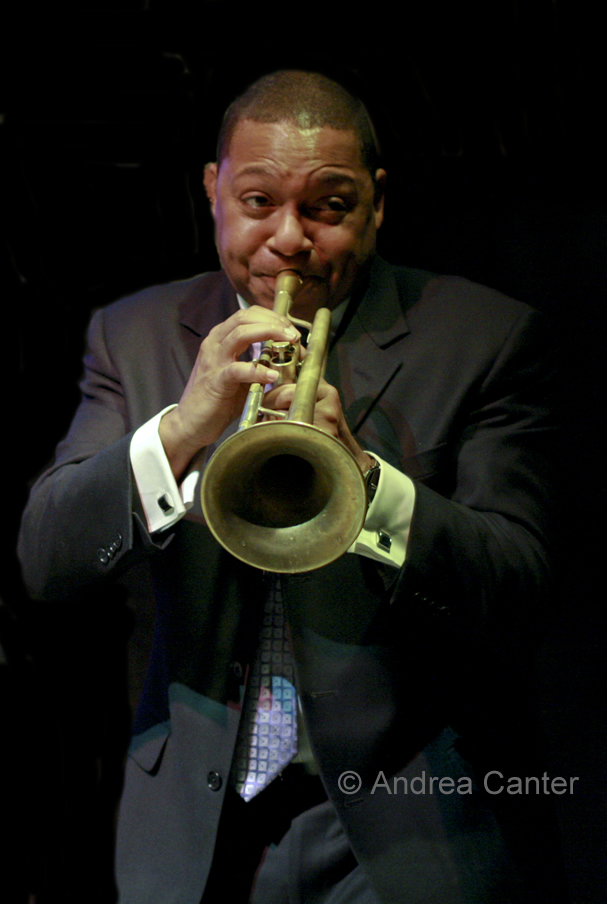
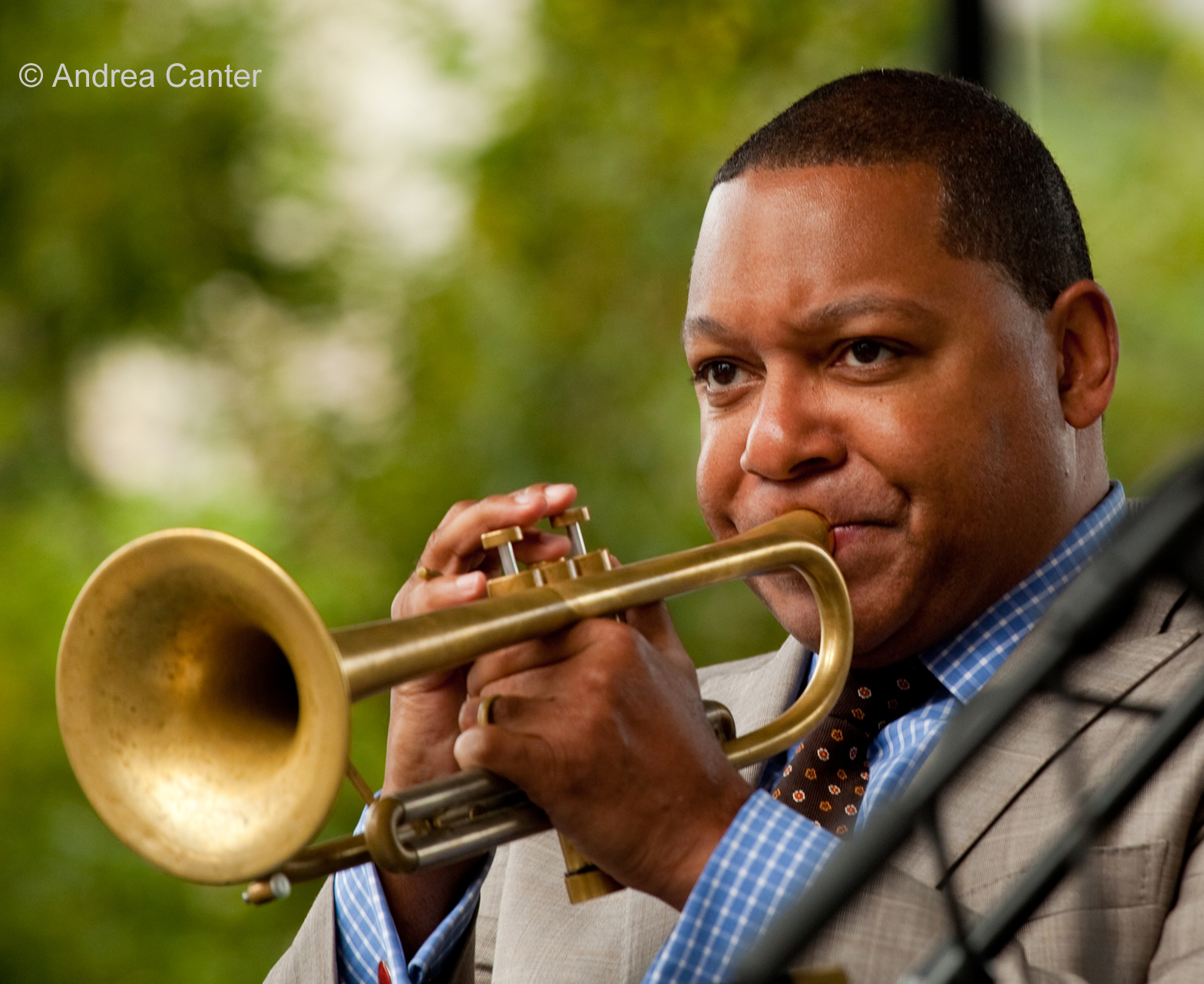
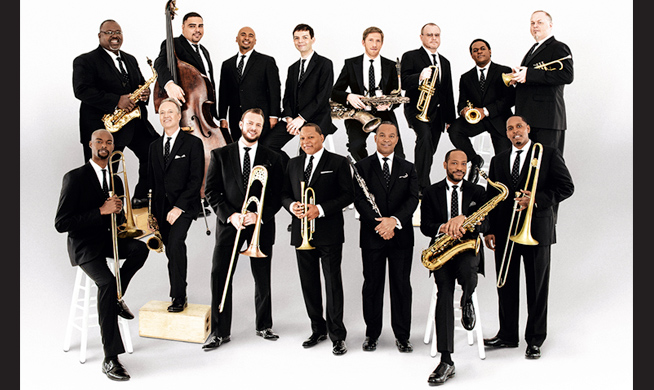
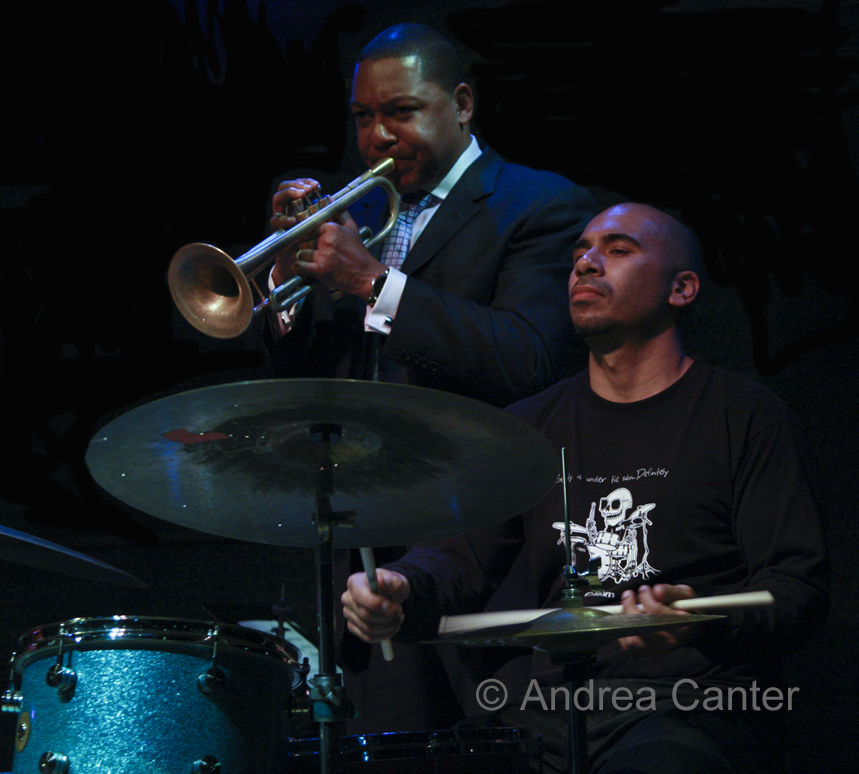
ImageWhen pianist/patriarch Ellis Marsalis retired from the faculty of the University of New Orleans in 2001, the school established a chair in his honor in the School of Music; the celebration concert was released asThe Marsalis Family: A Jazz Celebration (2003, Marsalis Music). Last year (2009), The Duke Ellington Jazz Festival in Washington, DC, presented Ellis Marsalis with its Lifetime Achievement Award. Another reason for a family celebration, the clan came together again, now released on Marsalis Music as Music Redeems. In addition to Ellis, the recording includes Wynton, Branford, Delfeayo and Jason, with support from bassist Eric Reavis and drummer Herlin Riley, guest Harry Connick, Jr., and brother Ellis III reciting an original poem. 

Adding to the energy of the music is the cause the recording supports: All proceeds from sales will benefit the new Ellis Marsalis Center for Music, the practice, teaching, recording and performing space under construction in the heart of the New Orleans Habitat Musicians' Village, a community center initiated by Branford and Connick following Hurricane Katrina for displaced area musicians. 

The recorded portion of the tribute kicks off in celebratory mode with the family quintet roaring through “Donna Lee”,  augmented by Jason’s agile whistling and trading bars with muted Wynton while Eric Reavis maintains a blistering walk. “Monkey Puzzle” was a piece the brothers recall playing early on, a swaying blues featuring Jason on vibes, with soulful solos from Branford and Ellis. Ellis goes it alone on his “After,” a composition that is bright and elegant, highlighting his melodic bent, inherent swing, and golden touch, undiminished at age 75. The horns sing out on Ellis’ “Syndrome,” harmonies delightfully out of register, Wynton joyful, Ellis giving it a bouncy swing. And what swings more than Ellis on “Sweet Georgia Brown?” Two piano—Ellis and Harry Connick, Jr. Together they partially deconstruct and otherwise add plenty of strut. Monk’s “Teo” gets a gleeful reading by the ensemble, Delfeayo stepping up with growly trombone solo punctuated heavily by Jason’s percussion. The music concludes with back-to-back tales of the Crescent City, from Jason (“At the House In Da Pocket”) and the traditional “Second Line,” the former spiced with licks from “Well You Needn’t” and Jason’s drum assault, the finale seemingly bringing the crowd to its feet in truly stompin’ New Orleans fashion. 

Ellis III read his poem, “The Man and the Ocean,” written a few weeks before the concert about “that bright shining light.” (Creativity in the Marsalis family is not limited to music.) The recording also includes some comments from Wynton, Branford and Harry Connick, Jr., who describes the Musicians’ Village and plans for the Ellis Marsalis Center for Music, noting, “There’s no better way to pass the tradition of New Orleans music on…” 

There is no better way to introduce the depth of the tradition than Music Redeems.

 
<< Start < Prev 1 2 3 4 5 6 7 8 9 10 Next > End >>

Results 55 - 60 of 131

Twin Cities Live Jazz Calendar

Follow Jazz Police on Twitter
Like Jazz Police on Facebook
 
Today's top ten jazz downloads
JP Archive
Add Jazz Police button to your google toolbar
Latest News


Lost Password?
Jazz Ink
 
Go to top of page  Home | New and Notable | Photo Galleries | CD/DVD/Book Reviews | Interviews | SF Bay Area | Chicago | Los Angeles | New York | Twin Cities, MN | Festivals | News | Follow Jazz Police on Twitter | Like the Jazz Police on Facebook |